
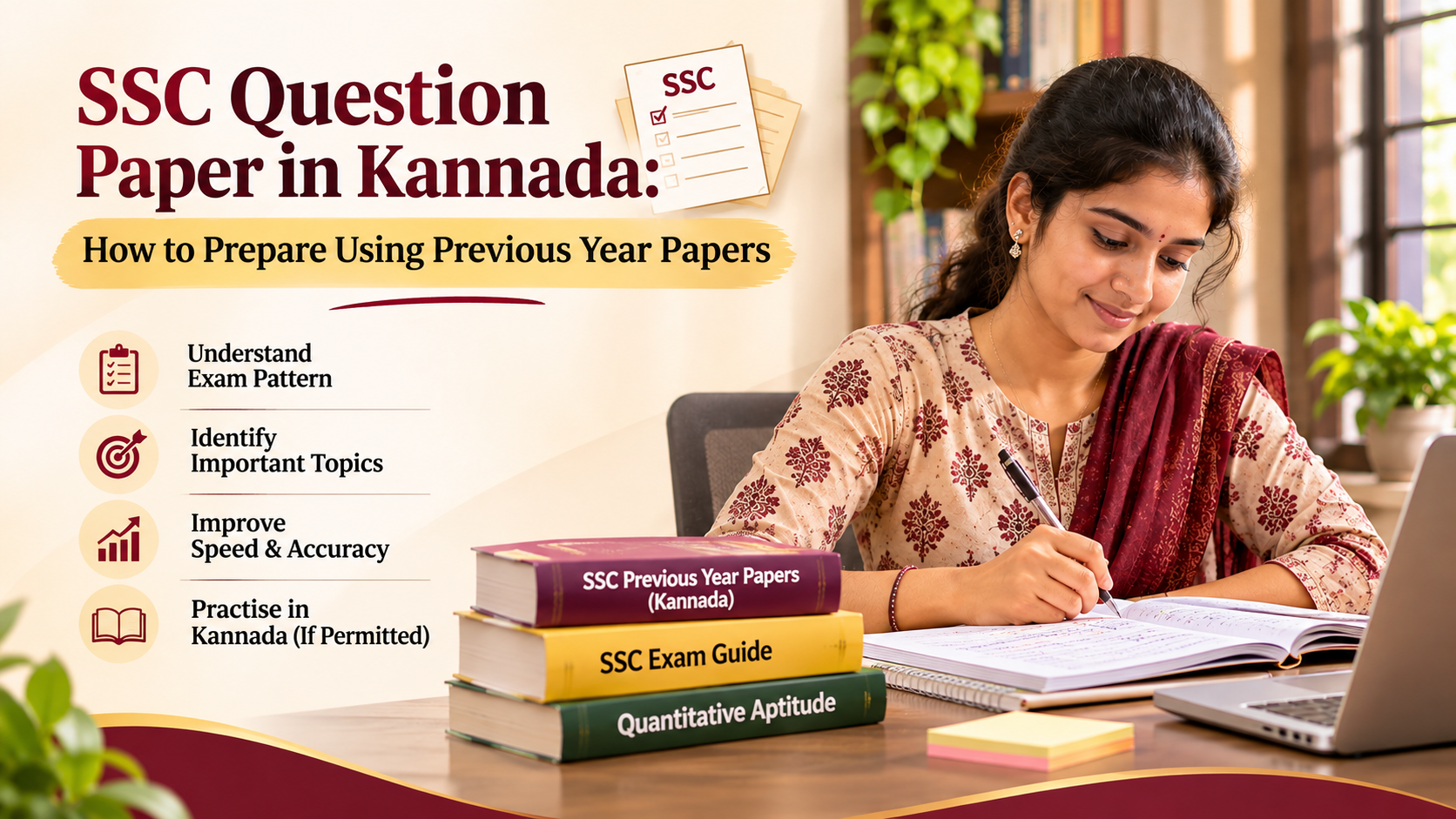
Preparing for a Staff Selection Commission (SSC) examination requires more than reading textbooks. Candidates must understand the exam pattern, practise different question types and manage time under pressure. For students in Karnataka who are comfortable learning in Kannada, previous year papers can make preparation more accessible.
An SSC question paper in Kannada can help eligible candidates understand questions in a familiar language and concentrate on concepts, accuracy and speed. However, language options differ across SSC examinations. Always check the latest notification for your specific exam before selecting a medium.
Which SSC Exams Offer Kannada Question Papers?
The Staff Selection Commission conducts several recruitment examinations, but Kannada is not available in every exam. Regional-language options, including Kannada, are provided in examinations such as Multi-Tasking Staff (MTS), Havaldar, Combined Higher Secondary (10+2) Level (CHSL) and Constable (GD), subject to the applicable notification and exam scheme.
This matters when searching for an SSC exam Kannada paper. A Kannada paper from one recruitment exam may not match another exam’s pattern or language rules. Check the official notification, syllabus and instructions for your target year. Also remember that sections such as English Language and Comprehension test English and must be prepared accordingly.
Why Practise with Previous Year SSC Question Papers?
Previous year papers show how syllabus topics are tested. The syllabus tells you what to study; question papers show how you must apply that knowledge within a time limit.
Previous year papers help you:
- Understand the pattern: Review sections, question formats, marks, duration and negative marking.
- Identify important topics: Notice concepts that appear across papers without assuming questions will be repeated.
- Assess preparation: Identify strong subjects and areas that need more attention.
- Improve speed and accuracy: Timed practice helps you answer efficiently and avoid careless mistakes.
- Build confidence: Familiarity with the format makes the actual test less unfamiliar.
An SSC question paper Kannada resource is particularly useful when Kannada is an approved medium for your chosen examination.
How to Prepare Using Previous Year Papers
1. Begin with the Latest Syllabus
Download the latest official notification and syllabus. Note the subjects, question count, marks, duration, language choices and negative marking.
2. Practise Topic by Topic
If you are a beginner, do not start with a full paper. Begin with sections such as Numerical and Mathematical Ability, Reasoning, General Awareness and English, as applicable to your exam. Practise one topic, review the method and gradually attempt mixed questions.
3. Attempt Full Papers with a Timer
Once your basics are clear, solve a complete SSC exam question paper in Kannada under exam-like conditions. Follow the time limit and avoid checking answers midway.
4. Analyse Every Mistake
Review incorrect answers and identify the cause: a concept gap, calculation error, misread question, guess or poor time management. Maintain a mistake notebook and revisit it during revision.
5. Measure Accuracy and Speed
Record the time taken, correct and incorrect answers, and unanswered questions after each practice session. Improve accuracy before trying to increase speed. Follow the marking scheme of your specific examination when evaluating performance.
6. Practise in Your Chosen Language
If the notification permits Kannada and you intend to select it, practise with reliable Kannada papers or mock tests. Pay attention to instructions, mathematical terms and question wording. Bilingual explanations can help you connect Kannada concepts with English terminology where useful.
Common Mistakes to Avoid
Collecting papers is not the same as using them effectively. Avoid solving tests without reviewing answers, memorising solutions without understanding them or relying on outdated patterns. Check the current syllabus and use dependable answer keys.
Do not ignore weaker subjects by repeatedly practising only familiar topics. Give extra time to areas where your accuracy is low. Also, begin mock tests well before the final weeks instead of postponing timed practice until the last moment.
Create a Practical Study Routine
A realistic timetable helps students and working professionals stay consistent. Divide available study time between concept learning, topic-wise questions and revision. Reserve a session each week for a full mock test and detailed analysis.
Keep your resources focused: the latest syllabus, reliable study material, previous year papers and relevant mock tests. Revising concepts and correcting repeated mistakes is more productive than collecting too many books or test series.
Prepare with Structured Guidance from Learn On-Line
Competitive exam preparation can feel difficult when you are unsure what to study or how to measure progress. Learn On-Line supports aspirants in Karnataka with coaching for SSC, banking and railway examinations.
Its learning approach includes Kannada and English explanations, structured lessons, practice, mock tests and performance analysis. Explore Learn On-Line’s SSC courses and test series to complement your own practice.
Turn Previous Year Papers into a Preparation Strategy
Previous year papers are most useful when treated as learning tools, not just tests. Understand the current exam requirements, practise relevant papers, analyse mistakes and revise consistently. If your chosen SSC examination permits Kannada, use that option thoughtfully while preparing every section in the prescribed syllabus.
With a clear plan, regular practice and appropriate guidance, you can approach your SSC preparation with greater confidence. Explore Learn On-Line for structured support on your competitive exam journey.
Review progress every week and adjust your timetable when needed.
 English