
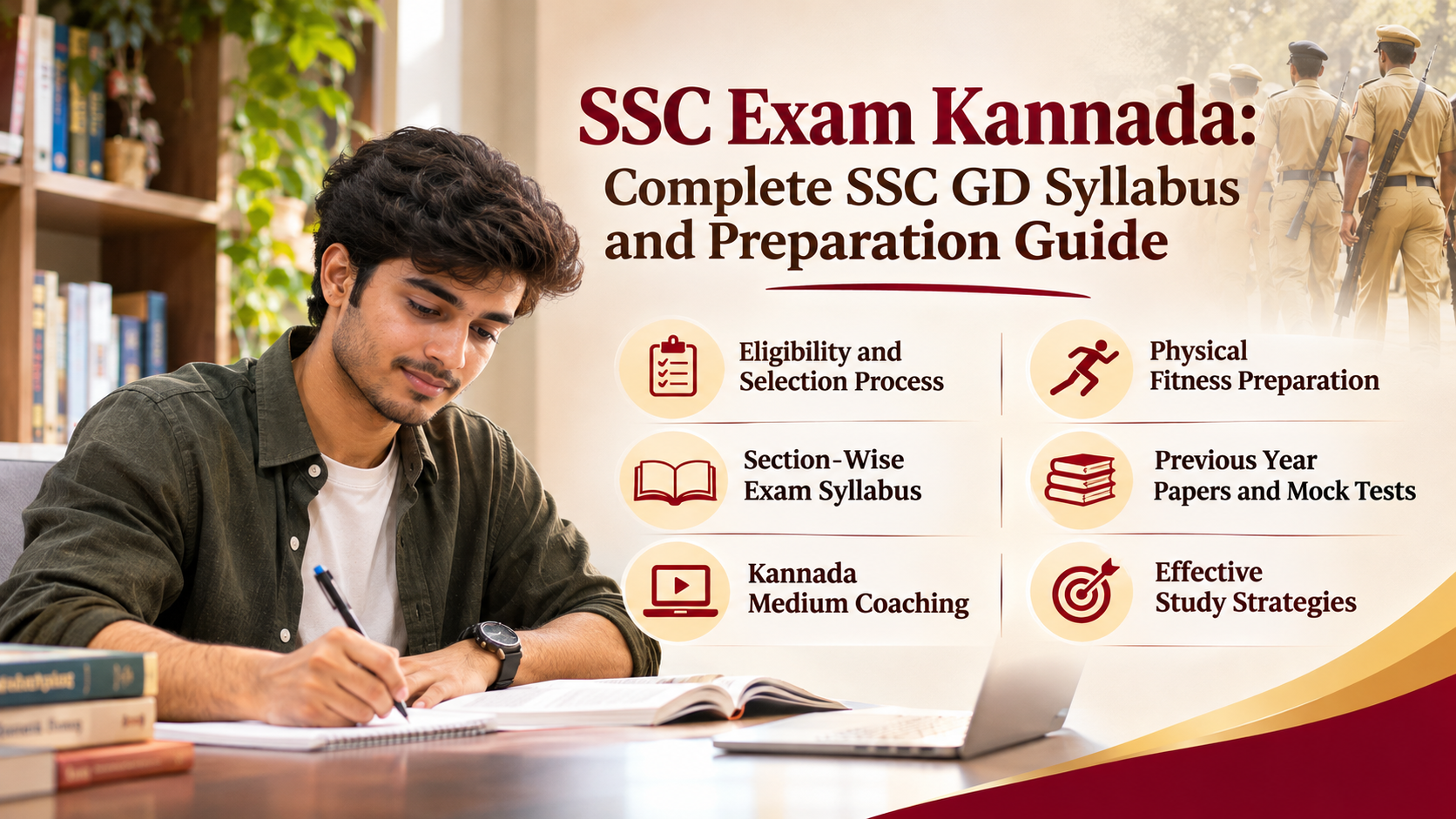
The SSC GD Constable exam is one of the most popular central government recruitment exams among 10th pass students across India, and for candidates in Karnataka, preparing with guidance in Kannada makes a substantial difference in how well the concepts are understood and retained. The Staff Selection Commission conducts the SSC GD recruitment to fill Constable positions in central armed police forces including CRPF, BSF, CISF, ITBP, SSB, NIA, SSF, and Assam Rifles, making it one of the more significant SSC exam Kannada-medium coaching opportunities for students who want a central government career after their 10th standard.
The challenge for many Karnataka students is not lack of motivation. It’s the shortage of structured, Kannada-medium coaching that breaks down the exam’s multiple stages and subject content in a way that is easy to absorb. The SSC GD is not just a written test; it involves physical tests, medical standards, and document verification, and understanding the full process clearly from the start helps candidates prepare for each stage without being caught off guard.
In this blog, we’ll walk through what the SSC GD exam involves, its selection stages, the written exam syllabus, preparation strategies, and the study resources that work best for Kannada-medium students in Karnataka.
What Is the SSC GD Constable Exam and Who Can Apply?
The SSC GD Constable exam is conducted by the Staff Selection Commission to recruit candidates for the post of General Duty Constable in several central armed police forces and other central government organisations. It is one of the most accessible central government exams because the minimum educational qualification required is passing 10th standard from a recognised board.
The age limit for applying is generally between 18 and 23 years, with standard relaxations available for OBC (3 years), SC/ST (5 years), and other reserved category candidates. For Karnataka students, this exam represents an opportunity to enter central government service directly after school, with a pay scale and job security that is difficult to match at this qualification level in the private sector. The selection process involves multiple stages, and understanding each one is essential before beginning preparation.
The SSC GD Selection Process: What Each Stage Involves
The SSC GD selection process is multi-stage and each stage is eliminatory, meaning candidates who do not clear one stage do not proceed to the next. Here is what each stage involves:
Computer Based Test (CBT)
The written exam is objective type and covers four sections: General Intelligence and Reasoning, General Knowledge and General Awareness, Elementary Mathematics, and English or Hindi. The exam has 80 questions carrying 160 marks, with a time limit of 60 minutes. There is a negative marking of 0.50 marks for each wrong answer, which makes accuracy more important than attempting every question. The CBT is the qualifying stage that determines whether a candidate proceeds to the physical tests, so the written exam deserves the bulk of preparation time and focus.
Physical Efficiency Test and Physical Standard Test
Candidates who clear the CBT are called for the Physical Efficiency Test (PET) and Physical Standard Test (PST). The PET involves a race: male candidates must complete 5 km in 24 minutes; female candidates must complete 1.6 km in 8.5 minutes. The PST checks height and chest measurements against the prescribed standards, which vary slightly by category and home state. Both must be cleared to proceed further, and physical fitness preparation should begin well before these tests are scheduled.
Medical Examination and Document Verification
Candidates who pass the PET and PST undergo a detailed medical examination that checks vision, hearing, and overall physical health against the standards prescribed for the post. Document verification follows, where original certificates are checked against the application details. Any discrepancy in documents at this stage can result in disqualification, so maintaining accurate records from the start of the application process is essential.
SSC GD Exam Syllabus in Kannada: Section-Wise Breakdown
Understanding the SSC GD exam syllabus in Kannada gives Karnataka students the clarity to plan their preparation by section rather than studying without direction. Each section of the CBT has a defined scope, and knowing that scope prevents wasted time on topics that fall outside the exam.
General Intelligence and Reasoning tests logical and analytical thinking through questions on analogies, series completion, coding-decoding, blood relations, and spatial reasoning. This is considered one of the most scorable sections because the question types repeat across years and can be mastered through pattern practice. General Knowledge and General Awareness covers current affairs, Indian history, geography, civics, science, and general science at a basic level; consistent daily reading of a Kannada newspaper and a current affairs summary builds this section steadily over months.
Elementary Mathematics covers topics from the 10th standard syllabus: number systems, fractions, percentages, ratios, averages, profit and loss, time and work, and basic geometry. The level is manageable for anyone who studied Mathematics up to 10th standard, but speed and accuracy require consistent practice rather than conceptual revision alone. The English or Hindi section tests basic grammar, vocabulary, and reading comprehension at a simple level; candidates from Karnataka who opt for Hindi instead of English should ensure they are equally comfortable with that choice before the exam.
SSC GD Exam in Kannada: Why the Medium of Instruction Matters
The SSC GD written exam is conducted in English and Hindi, but how you learn during preparation is a separate matter. For candidates whose schooling was in Kannada medium, understanding reasoning patterns, mathematical shortcuts, and general knowledge concepts in Kannada during the learning phase produces stronger comprehension than trying to absorb new concepts through an unfamiliar language simultaneously.
The SSC GD exam in Kannada coaching approach focuses on building the foundation clearly first, in a language that feels natural, and then applying that foundation to English or Hindi question formats in the actual exam. This is a more efficient path than struggling through English-medium coaching while also trying to understand the concept itself. Learn On-Line’s coaching for Karnataka students addresses this directly, with Kannada-medium instruction across all four sections of the GD CBT, alongside structured doubt-clearing and mock tests that reflect the actual exam pattern.
How Should You Prepare for the SSC GD Physical Tests?
The physical preparation for PET is something that many candidates underestimate until it is too late to build the required fitness level. The 5 km run in 24 minutes for male candidates and 1.6 km run in 8.5 minutes for female candidates are not casual jogs; they require a reasonable level of cardiovascular fitness that takes consistent training over several weeks to develop.
Starting a running routine at least three to four months before the expected PET date gives most candidates adequate time to build from a comfortable base to the required standard. Beginning with shorter distances at a moderate pace and progressively increasing distance and pace weekly is more effective than starting with the full distance at race speed. Alongside running, basic strength and flexibility work supports the PST physical standards and reduces injury risk during the race. Candidates who focus only on the written exam and neglect physical preparation frequently clear the CBT but fail the PET, losing the opportunity at the final stage.
Study Resources That Work for Karnataka Students
Previous year SSC GD question papers are the most useful resource available for CBT preparation. They reveal the actual difficulty level, the specific question types that appear repeatedly, and the distribution of marks across sections. Solving these under timed conditions gives a realistic sense of where preparation stands and what needs more attention.
Online mock tests that simulate the computer-based exam interface are essential, since familiarity with the format saves time during the actual test. For Kannada-medium candidates, coaching programmes that provide video explanations in Kannada, structured study plans, and regular doubt-clearing sessions remove the friction that self-study through English-medium materials creates. Learn On-Line’s SSC GD coaching for Karnataka students is built around these specific needs, covering both the written exam content and guidance on the broader selection process in a format that works for Kannada-medium learners.
Conclusion
The SSC GD Constable exam offers Karnataka students a clear and accessible path into central government service, and preparing for the SSC exam Kannada medium gives candidates a meaningful advantage in building the understanding needed to perform well across all stages of selection. Knowing the full process, the syllabus section by section, and what each physical test demands makes preparation more focused and less overwhelming.
Consistency across both written preparation and physical fitness training is what separates candidates who clear all stages from those who fall short at one of them. Starting early, following a structured plan, and accessing coaching that works in Kannada rather than around it sets the right foundation for a result that the preparation time deserves.
 English