
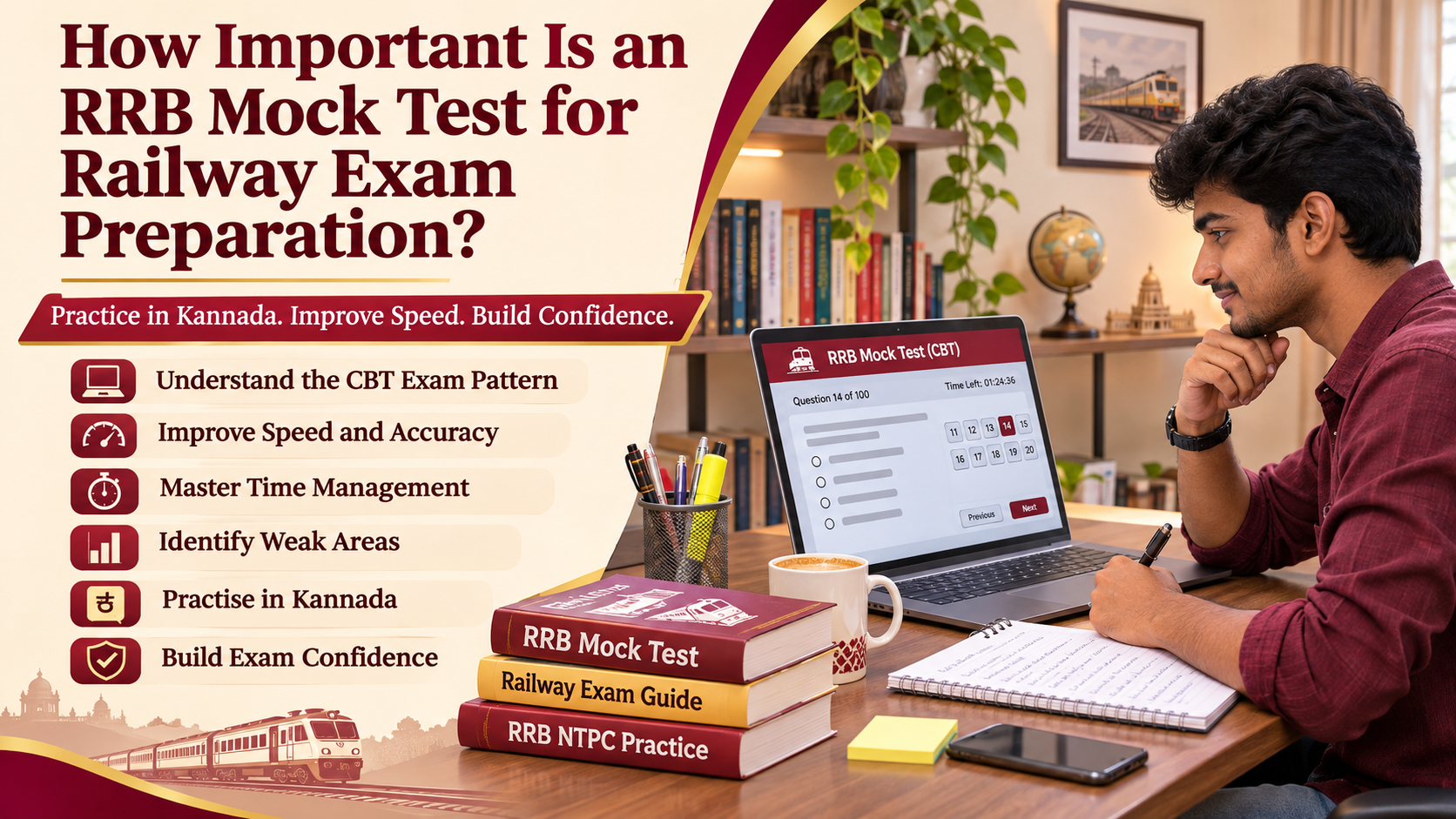
RRB exams are among the most competitive government recruitment exams in India, drawing millions of applicants for a relatively small number of posts. The candidates who consistently clear them tend to share one preparation habit: they treat mock tests as a core part of studying, not something to do in the final week. For Karnataka aspirants, taking an RRB mock test Kannada medium specifically removes an extra layer of cognitive friction and makes the practice experience feel closer to the actual exam, which matters more than most candidates realise until they’re sitting in the test centre.
Many aspirants study thoroughly and still find the exam harder than expected. Not because they didn’t know the material, but because they weren’t prepared for the experience itself: the pressure of a timed computer-based test, the disorientation of unfamiliar navigation controls, and the constant awareness of a countdown timer. Mock tests are what bridge the gap between knowing the subject and performing under real exam conditions.
In this blog, we’ll walk through what an RRB mock test actually prepares you for, why time management is the central skill it builds, how to use test analysis to identify weak areas, and why attempting the mock test in Kannada matters for Karnataka aspirants.
What Makes an RRB Mock Test Essential for Exam Preparation?
RRB NTPC and Group D are Computer Based Tests, which means the exam is conducted on-screen with on-screen navigation, a visible countdown timer, and a question-flagging system that lets you mark questions for review. For candidates who have not taken a CBT before, this interface is genuinely unfamiliar, and encountering it for the first time during the actual exam creates a problem. The first few minutes of the exam become an orientation session rather than productive answering time.
A mock test replicates this environment accurately enough that by the time you sit the real exam, the interface is not a variable anymore. You’ve already navigated it dozens of times. You know exactly how to flag a question and return to it, how to track how many questions remain unanswered, and what it feels like to manage your pace against a timer. That familiarity is not a minor comfort; it’s a genuine performance factor.
Negative marking adds another dimension that only practice can teach. Most RRB exams deduct a third of a mark for each wrong answer. The strategic question of when to attempt and when to skip is not something you can reason through in the abstract; it’s a judgment call that improves with repeated exposure. Candidates who have taken twenty timed practice tests under real conditions make those calls more accurately than candidates who have only thought about them theoretically.
Time Management Is the Core Skill and Mock Tests Build It
RRB NTPC CBT 1 gives candidates 90 minutes for 100 questions across Mathematics, General Intelligence and Reasoning, and General Awareness. That’s just under a minute per question on average, and in practice the distribution of your time should not be even across all questions. Easy questions should be answered quickly and banked; medium questions get a fair attempt; difficult questions get flagged and returned to if time allows. That system works, but only if it’s been practised enough to become instinctive rather than deliberate.
Working professionals preparing alongside a job cannot afford to spend months discovering through trial and error how their time is going during the exam. Each mock test tells them directly which section is slowing them down, whether they’re spending too long on Mathematics at the expense of General Awareness, and whether their current pace is sustainable across a full paper. That information changes preparation decisions in a way that reading about time management strategies does not.
Using Test Analysis to Find and Fix Weak Areas
A mock test taken without analysis afterwards is a missed opportunity. The score matters, but what the score breakdown reveals matters more. Section-wise results across the paper tell you which topics are genuinely solid and which only feel solid in a low-pressure environment. Patterns that emerge across multiple tests, particular question types you get wrong consistently, or sections where your accuracy falls under time pressure, are the signals that should drive what you study next.
RRB mock tests taken regularly across the preparation period build a picture of real progress over time. A candidate who takes ten full tests with serious review after each one arrives at the exam knowing their strengths and weaknesses with unusual precision. That self-awareness changes how they approach the question paper on exam day, allowing them to allocate time and effort where it’s most likely to produce correct answers rather than distributing it evenly regardless of personal performance data.
Why Taking the RRB Mock Test in Kannada Specifically Matters
RRB exams offer Kannada as a language option, and candidates who plan to write the exam in Kannada should practise in the same language from the beginning. The reason is not sentimental; it is practical. Reading comprehension and processing speed are measurably faster in a language a person thinks in naturally than in one they’ve learned as a second language. In a 90-minute exam where every second counts, the mental cost of translating each question from English into Kannada before processing it is real and cumulative.
An RRB mock test in Kannada exposes you to the specific way questions are phrased in Kannada, which is not always a direct translation. Mathematical word problems, Reasoning analogies, and General Awareness questions each have characteristic phrasings in Kannada that feel natural once familiar and disorienting the first few times you encounter them. Discovering that unfamiliarity during practice, not during the real exam, is the entire point. An RRB Kannada mock test from a platform that accurately reflects the exam’s difficulty level and interface gives you exactly that exposure without any stakes attached.
How Many Mock Tests Should You Take and When?
Timing the introduction of mock tests into your preparation matters. Starting full-length tests too early, before the core syllabus topics are in place, produces scores that say more about what hasn’t been covered yet than about preparation quality. A more productive approach is to begin regular full mock tests once roughly 60 to 70 percent of the syllabus has been covered, at which point the tests have enough material to work with and enough gaps to usefully surface.
As the exam approaches, increase frequency steadily. In the final six to eight weeks, two to three full-length mock tests per week with thorough review after each one is a sustainable and productive rhythm. The goal by the week of the exam is not to be discovering new weaknesses but to have already addressed them through targeted revision. The pattern of study, test, analyse, revise, test again is what produces consistent improvement rather than just repeated practice at the same level.
Conclusion
An RRB mock test Kannada aspirants take in their actual examination language is not a supplementary activity. It is the closest available simulation of the real exam and builds capabilities that subject study alone cannot: familiarity with the CBT interface, time management under real pressure, strategic decision-making around negative marking, and the kind of exam temperament that only comes from having been through the experience repeatedly before it counts.
Preparation builds the knowledge base; mock tests build the ability to demonstrate that knowledge under conditions that are as close to the actual exam as practice can provide. The candidates who do both seriously, and who analyse each test before moving on to the next, are the ones who perform to their real potential on the day that matters. That combination is straightforward to build into any preparation plan, and it is worth starting sooner rather than later.
 English