
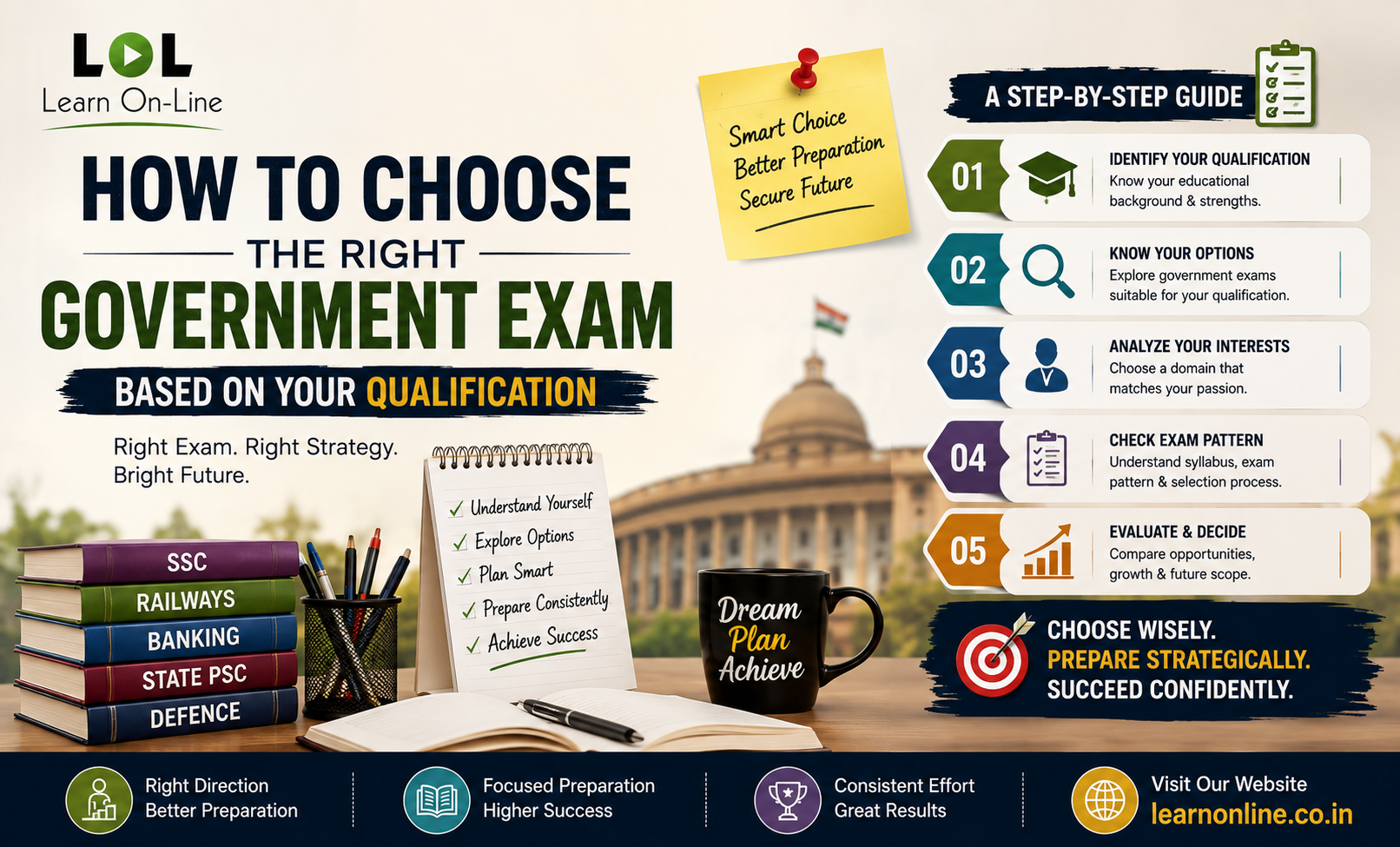
How to Choose the Right Government Exam Based on Your Qualification
With SSC, Banking, Railways, UPSC, and dozens of state-level bodies all recruiting at once, picking the right government exam by qualification is often more confusing than the preparation itself. The good news: your qualification alone rules out most of the noise and narrows the field to a handful of exams worth your time.
This guide breaks down which exams fit which qualification level, so you can stop scrolling exam lists and start preparing.
Why Qualification Should Be Your First Filter
Before comparing difficulty, salary, or syllabus, check eligibility — it’s the fastest way to cut a long list down to a short one. Preparing for an exam you’re not eligible for, or missing one you already qualify for, wastes months that could go toward actual preparation. Qualification also often signals the level of job you’ll get — clerical, supervisory, or officer-level — so it shapes your long-term career path, not just your starting exam.
If You’re a 10th Pass Candidate
At this stage, your options are focused on support-staff and constable-level roles.
- SSC MTS (Multi-Tasking Staff) — support roles across central government departments
- Railway Group D — track maintenance, technician assistant, and similar posts
- State Police Constable exams — vary by state but generally accept 10th or 12th pass.
- Postal Circle GDS (Gramin Dak Sevak) — rural postal roles with flexible eligibility
These exams typically have simpler syllabi, making them a practical entry point if you want a government job quickly while continuing further education alongside.
If You’re a 12th Pass Candidate
This is where the option pool widens significantly.
- SSC CHSL — clerical and data-entry roles like LDC/JSA, Postal Assistant, and DEO
- Railway NTPC (Undergraduate level) — non-technical roles across Indian Railways
- SSC GD Constable — paramilitary and police forces
- Banking exams via IBPS RRB Office Assistant — rural bank clerical posts
- NDA (National Defence Academy) — for those targeting a defence career right after school
If you’re still deciding between working now or pursuing graduation, note that CHSL and NTPC are strong entry points that don’t close the door on graduate-level exams later.
If You’re a Graduate
This is the largest and most competitive tier of government exams by qualification.
- SSC CGL — officer and supervisory-level posts like Inspector, Auditor, and Assistant Section Officer
- IBPS/SBI PO and Clerk — banking sector roles across public sector banks
- UPSC Civil Services — IAS, IPS, IFS, and allied services (India’s most competitive exam)
- State PSC exams — state-level equivalents of UPSC, often with slightly lower competition
- RRB NTPC (Graduate level) and RRB JE (for engineering graduates)
- CTET/State TET — for those with a B.Ed or equivalent, targeting teaching roles
Graduates preparing for SSC CGL should note the syllabus overlaps heavily with SSC CHSL — see our comparison of SSC CGL vs CHSL if you’re deciding between the two.
If You Have a Technical or Professional Degree
Engineering, medical, and law graduates have a separate set of specialized exams worth knowing about.
- Engineering graduates: SSC JE, RRB JE, ESE/IES (Engineering Services Examination), and PSU recruitment through GATE scores
- Medical graduates: UPSC Combined Medical Services, state health department recruitment
- Law graduates: Judicial Services Examinations, PSU legal officer posts
- CA/CS/CMA: RBI Grade B, PSU finance officer roles, SEBI Grade A
These exams often carry less competition per seat than generalist exams like SSC CGL, simply because the eligible pool is smaller.
If You Have a Postgraduate Degree or Higher
A postgraduate degree doesn’t unlock many exclusive exams, but it does open a few specialized routes:
- UPSC and State PSC — postgraduates are eligible and often preferred for specific specialist posts
- RBI Grade B / NABARD Grade A — economics, finance, or agriculture postgraduates get a natural advantage
- University Assistant Professor roles (via UGC NET) — for those aiming at academia over administrative roles
For most postgraduates, graduation-level eligibility already covers 90% of relevant exams — the postgraduate degree mainly adds an edge in interviews or specialist recruitment rather than opening entirely new doors.
A Simple Decision Framework
- Check your exact qualification and age against each exam’s official eligibility criteria first — don’t rely on general guides alone.e
- Shortlist 2-3 exams, not one, since overlapping syllabi mean minimal extra effort
- Pick based on your timeline — if you need a job sooner, favor exams with fewer stages; if you can invest 1-2 years, aim higher (UPSC, SSC CGL, Banking PO)
- Confirm final eligibility on the official exam body’s website before you commit months of preparation.n
Once you’ve shortlisted your exam, build your prep timeline around the notification cycle — our Government Exam Calendar 2026 covers SSC, Banking, and Railway notification windows so you’re not caught off guard.
Final Word
Choosing the right government exam by qualification isn’t about finding the “best” exam in the abstract — it’s about matching your current eligibility, timeline, and career goals to the exams that are actually open to you. Start with what you qualify for today, and let your longer-term goals guide which 2-3 exams you commit real preparation time to.
Eligibility criteria, including qualification and age limits, are set by each exam body and revised periodically — always verify against the official notification (SSC, IBPS, UPSC) before applying.
 English