
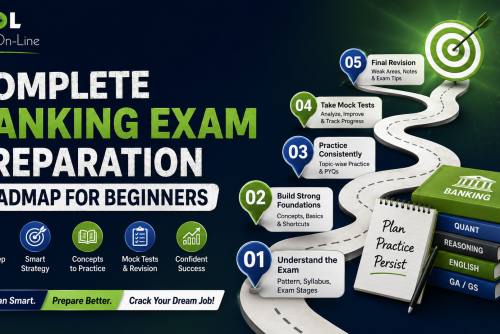
Complete Banking Exam Preparation Roadmap for Beginners
Starting your banking exam preparation with no clear starting point is one of the biggest reasons beginners lose momentum in the first few months. Between IBPS, SBI, RBI, and regional rural banks, the number of exams alone can feel overwhelming before you’ve even opened a book.
This roadmap breaks the journey into a clear sequence — from understanding the exam landscape to your first full-length mock — so you know exactly what to do in month one, and what to save for later.
Step 1: Understand the Banking Exam Landscape
Before opening any study material, get clarity on which exams actually exist and who they’re for.
- IBPS PO/Clerk — recruits for public sector banks other than SBI; the largest source of banking vacancies each year
- SBI PO/Clerk — conducted separately by State Bank of India, generally considered slightly tougher due to higher competition
- RBI Grade B/Assistant — central bank roles with a different, often more analytical, exam pattern
- IBPS RRB — for Regional Rural Banks, with a comparatively simpler General Awareness section focused on rural and agricultural banking
Most beginners should start preparing for IBPS and SBI Clerk or PO together, since the syllabus overlaps heavily — RBI and specialist roles are usually a second-stage goal once the fundamentals are solid.
Step 2: Know the Exam Pattern Before You Start Your Banking Exam Preparation
Every major banking exam follows a similar two- or three-stage structure: Prelims → Mains → Interview/Group Exercise (for PO-level posts). Prelims typically test four sections — Reasoning, Quantitative Aptitude, English Language, and sometimes Computer Aptitude — under a strict sectional time limit. Mains adds Banking Awareness/General Awareness and more advanced versions of the same core sections.
Understanding this structure early prevents a common beginner mistake: over-preparing for Mains-level difficulty while still weak on Prelims-level speed.
Step 3: Build Your Subject-Wise Foundation (Months 1–2)
This is the base-building phase — no mock tests yet, just concept clarity.
- Quantitative Aptitude: Start with number system, simplification, percentages, and ratios before moving to Data Interpretation
- Reasoning: Begin with puzzles and seating arrangements, since they carry the highest weightage across most banking exams
- English Language: Build a daily vocabulary habit alongside grammar rules — Reading Comprehension improves fastest with consistent daily reading
- Banking Awareness: Start early since this section rewards long-term memory over last-minute cramming
Spend these two months on NCERT-level clarity and topic-wise practice sets — not full mocks. Trying to attempt a complete paper before the fundamentals are solid usually just produces a discouraging score.
Step 4: Shift to Practice and Speed Building (Months 3–4)
This is the phase where banking exam preparation shifts from “can I solve this” to “how fast can I solve this.”
- Attempt sectional tests for each subject, timed strictly
- Track accuracy and speed separately — a topic solved slowly but correctly still needs work
- Start solving Data Interpretation sets that mix multiple concepts, since these dominate the Quant section in Mains-level exams
- Build reasoning speed with daily puzzle-solving, since puzzles alone often account for 15-20 marks in banking Prelims
By the end of month four, you should be comfortable attempting a full Prelims-level section within its time limit, even if accuracy isn’t perfect yet.
Step 5: Full-Length Mocks — The Final Stage of Banking Exam Preparation
This is where banking exam preparation starts resembling the real exam.
- Attempt one full mock every 3-4 days under strict exam conditions
- After each mock, spend at least 30-40 minutes reviewing mistakes — this review is often more valuable than the mock itself
- Maintain an error log categorizing mistakes as concept gaps, silly errors, or time-pressure errors
- Gradually shift toward Mains-pattern mocks once Prelims-level scores stabilize
Consistency matters more than volume here — five well-analyzed mocks a week beat ten mocks attempted without review.
Common Mistakes Beginners Should Avoid
- Starting with mocks too early, before concepts are solid, which mostly damages confidence
- Ignoring Banking Awareness until the last month, when it actually rewards early, steady revision
- Studying every topic equally, instead of weighting effort toward high-scoring areas like puzzles and DI
- Skipping error analysis, which means the same mistakes repeat across every mock
- Comparing your timeline to others’, when banking exam preparation length genuinely varies by starting level
A Simple 6-Month Timeline for Banking Exam Preparation
| Months | Focus |
|---|---|
| 1–2 | Concept building, topic-wise basics |
| 3–4 | Sectional practice, speed building |
| 5–6 | Full-length mocks, error analysis, Mains-level practice |
This timeline assumes you’re starting close to zero. If you already have a Reasoning or Quant background, months 1-2 can compress significantly. Once your notification is announced, pair this roadmap with our Government Exam Calendar 2026 to time your prep against real IBPS and SBI dates, and switch to our 30-Day Revision Strategy in your final month.
Final Word
A structured banking exam preparation roadmap isn’t about studying more hours — it’s about studying the right things in the right order. Build concepts first, add speed next, then test yourself under real conditions. Beginners who follow this sequence consistently tend to outperform those who jump straight into mocks without a foundation, no matter how many hours they put in.
Preparation timelines vary by starting level and target exam — adjust the pacing above to your own baseline rather than following it rigidly. Always check ibps. in for the latest official notification before finalizing your exam-wise plan.