
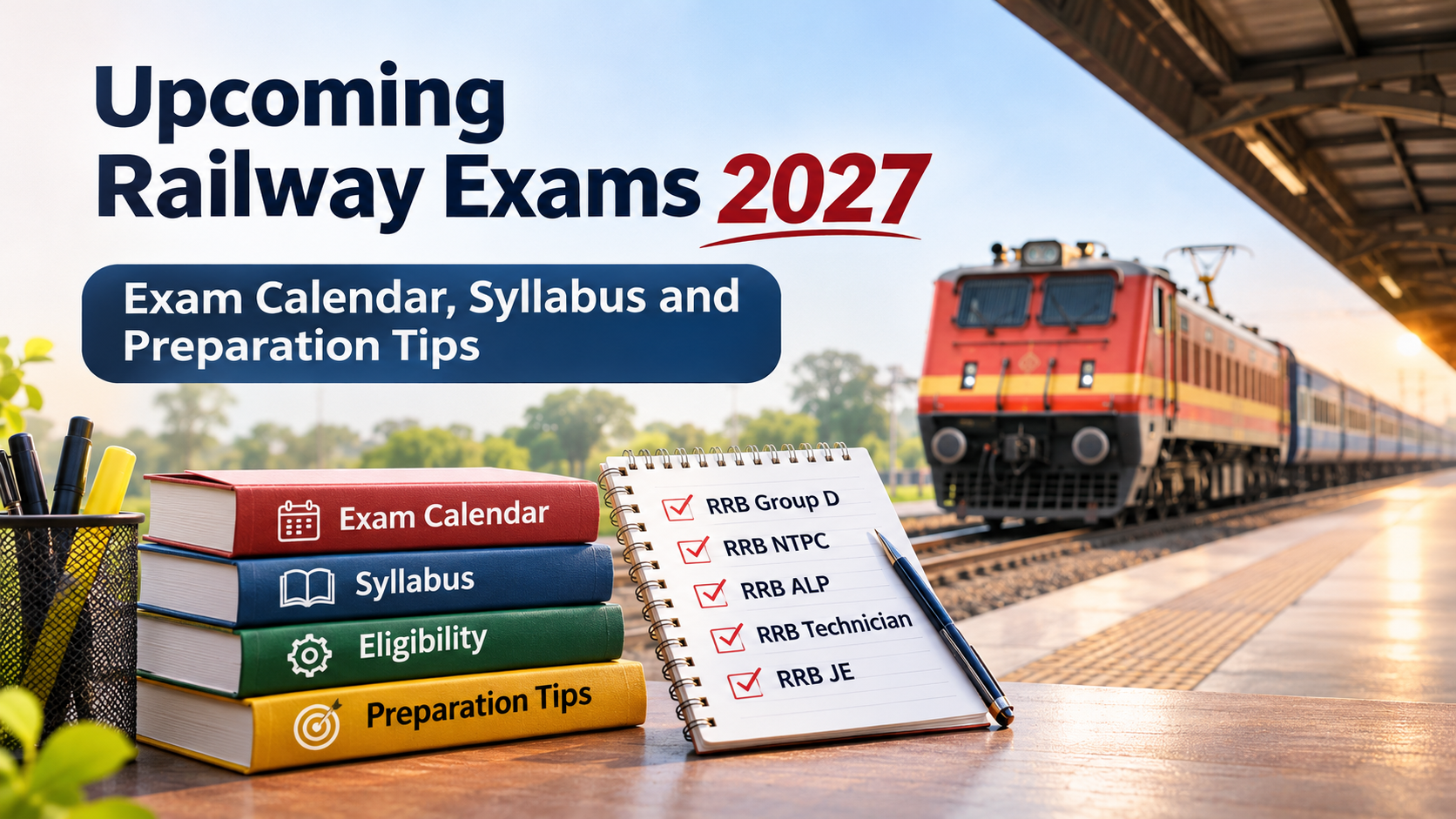
Railway recruitment examinations offer opportunities for candidates with different educational qualifications, from Class 10 and ITI to graduates and engineering professionals. Conducted by the Railway Recruitment Boards (RRBs), these examinations recruit candidates for various technical, non-technical and operational positions across Indian Railways. For aspirants planning their careers, keeping track of the upcoming railway exams 2027 is an important first step.
However, preparing for railway recruitment requires more than following notification dates. Candidates need to understand the eligibility requirements, examination patterns and subject-wise syllabus for their preferred posts. Starting early gives students and working professionals enough time to strengthen their fundamentals, practise previous-year questions and improve their examination performance.
1. Upcoming Railway Exams 2027: What Candidates Should Expect
The Railway Recruitment Boards conduct different examinations depending on the nature of the job and the educational qualifications required. Some major recruitment categories that candidates should watch for in 2027 include:
| Railway examination | Typical posts |
| RRB Group D (Level 1) | Track Maintainer, Pointsman and other Level 1 posts |
| RRB NTPC | Station Master, Goods Train Manager, Clerk and other graduate or undergraduate posts |
| RRB ALP | Assistant Loco Pilot |
| RRB Technician | Technician Grade I and Grade III |
| RRB JE | Junior Engineer and related technical posts |
| RRB Paramedical | Nursing and other paramedical positions |
| Ministerial and Isolated Categories | Various specialised positions |
These categories offer different career opportunities. For example, RRB Group D is relevant to candidates with prescribed basic educational and technical qualifications, while RRB NTPC includes graduate and undergraduate posts. Engineering graduates and diploma holders may explore RRB JE, depending on the specific eligibility conditions.
Before applying, check the educational qualifications, age limits, medical standards and other requirements mentioned in the relevant notification.
2. Railway Exam Calendar 2027: Notifications and Important Dates
An examination calendar helps candidates understand when recruitment activities may take place. However, it is important to distinguish between an annual recruitment calendar and confirmed examination dates.
The Railway Board’s 2026 annual recruitment calendar outlined recruitment-planning activities across several categories, including ALP, Technician, Section Controller, Junior Engineer, Paramedical, NTPC, Ministerial and Isolated Categories, and Level 1 posts. These planning windows indicate the intended recruitment schedule rather than confirmed 2027 examination dates.
As of October 2026, candidates should treat the following as recruitment categories to monitor, not as a confirmed 2027 examination timetable.
| Recruitment category | What candidates should monitor |
| RRB Group D | Level 1 recruitment notification and application dates |
| RRB NTPC | Graduate and undergraduate recruitment announcements |
| RRB ALP | Assistant Loco Pilot vacancies and eligibility |
| RRB Technician | Technical recruitment notifications |
| RRB JE | Junior Engineer recruitment announcements |
| Paramedical | Healthcare-related railway vacancies |
| Ministerial and Isolated Categories | Specialised post notifications |
Once a notification is released, candidates should check the application deadline, examination schedule, city intimation slip and admit card updates. Visit the official RRB websites regularly for authentic information. Avoid relying entirely on unofficial social media announcements.
3. Understand the Railway Exam Syllabus
Although different railway examinations have different patterns, several subjects appear across multiple recruitment categories. Understanding these common topics can help candidates organise their railway exam preparation more effectively.
| Subject | Important topics |
| Mathematics | Number systems, percentages, ratio, averages, profit and loss, time and work |
| General Intelligence and Reasoning | Analogy, coding-decoding, series, classification, directions and syllogism |
| General Science | Physics, Chemistry and Biology |
| General Awareness | Current affairs, history, geography, polity, economy, sports and science |
| Technical Subjects | Relevant engineering or trade-specific topics for technical recruitment |
Candidates preparing for Group D should pay particular attention to mathematics, reasoning, general science and general awareness. Those targeting technical positions such as ALP, Technician or JE must also study the relevant technical subjects.
The exact syllabus and weightage can differ between examinations. Download the latest notification and syllabus for your selected post instead of assuming that every railway examination follows the same pattern.
4. How to Start Railway Exam Preparation
A structured approach can help beginners avoid confusion and make better use of their available study time.
Understand your eligibility and select an examination
Start by identifying which railway posts match your educational qualifications, age and career interests. Avoid preparing for multiple examinations without understanding their different requirements.
Build strong fundamentals
Begin with basic mathematics and reasoning concepts. Practise calculations, understand formulas and solve introductory problems before moving towards more difficult questions.
Develop general awareness
Read about Indian history, geography, polity, science and important current affairs. Spend some time every day revising important events and maintaining short notes.
Practise previous-year questions
Previous-year question papers help you understand question formats, frequently tested concepts and the level of difficulty. They also help you identify subjects that require additional attention.
Attempt mock tests regularly
Begin with topic-wise tests and gradually move towards full-length mock examinations. Analyse incorrect answers and revise the concepts behind them instead of simply checking your score.
5. RRB Group D Exam Preparation: A Beginner-Friendly Strategy
RRB Group D is an important option for candidates seeking Level 1 railway positions. A systematic approach to RRB Group D exam preparation can help beginners develop the subject knowledge and examination skills required.
Under the previous Group D examination pattern, the Computer-Based Test covered four main areas:
- Mathematics
- General Intelligence and Reasoning
- General Science
- General Awareness and Current Affairs
Candidates should use this structure as a preparation reference while checking the next official notification for any changes to the examination pattern, marking scheme or selection process.
In addition to written preparation, candidates should pay attention to physical fitness. The recruitment process may include a Physical Efficiency Test (PET), depending on the applicable notification. Regular walking, jogging and basic strength exercises can help build stamina gradually. Candidates should also understand the prescribed physical requirements and prepare accordingly.
6. Create a Practical Daily Study Timetable
A realistic timetable helps candidates balance different subjects without feeling overwhelmed. Students can dedicate longer study sessions, while working professionals can divide their preparation into shorter sessions before and after work.
Here is a sample daily timetable:
| Study activity | Suggested time |
| Mathematics | 45 minutes |
| Reasoning | 45 minutes |
| General Science | 40 minutes |
| General Awareness and Current Affairs | 30 minutes |
| Revision and practice questions | 30 minutes |
| Total | 3 hours 10 minutes |
Use weekends to attempt full-length mock tests, review mistakes and revise completed chapters. If you have limited time, begin with shorter sessions and gradually increase your study hours.
7. How Online Coaching Can Support Railway Exam Preparation
Preparing independently can be challenging when candidates struggle to understand certain topics or maintain a consistent schedule. Structured online coaching can provide access to organised lessons, practice materials and trainer support.
When selecting a course, look for features such as:
- Live and recorded classes for flexible learning.
- Kannada and English instruction for better accessibility.
- Regular mock tests to evaluate performance.
- Digital and printed study notes for revision.
- Trainer-led doubt-clearing sessions.
- Guidance on physical and medical requirements, where applicable.
Learn On-Line offers competitive examination coaching with Kannada and English learning options, live and recorded classes, weekly full-length mock tests and trainer-led doubt-clearing support. These resources can help Karnataka students and working professionals follow a more organised preparation routine.
Explore the Learn On-Line website to learn more about its available coaching resources.
8. Common Mistakes Railway Exam Aspirants Should Avoid
Even dedicated candidates can lose valuable preparation time by making avoidable mistakes. Keep these points in mind:
- Waiting for notifications: Start building your fundamentals before recruitment announcements are released.
- Ignoring eligibility: Check educational qualifications, age limits and other requirements before choosing an examination.
- Following outdated syllabi: Always refer to the latest official notification.
- Neglecting technical subjects: Candidates applying for technical positions must allocate sufficient time to their specialised subjects.
- Skipping mock-test analysis: Understand your mistakes and work on improving accuracy.
- Using too many resources: Follow a manageable selection of reliable books, classes and practice materials.
9. Prepare Early and Stay Consistent
The upcoming railway exams 2027 provide opportunities for candidates from different educational backgrounds to pursue careers in Indian Railways. However, successful preparation begins with understanding the recruitment categories, checking eligibility and following the correct syllabus. Rather than waiting for confirmed examination dates, start strengthening your fundamentals, practising questions and reviewing your progress regularly.
For students and working professionals in Karnataka, structured online coaching can make preparation more accessible through flexible classes, bilingual instruction and regular mock tests. With a realistic timetable, consistent revision and the right learning resources, you can build a strong foundation for your chosen railway examination. Keep monitoring official RRB announcements and adjust your preparation according to the latest recruitment requirements.
 English