
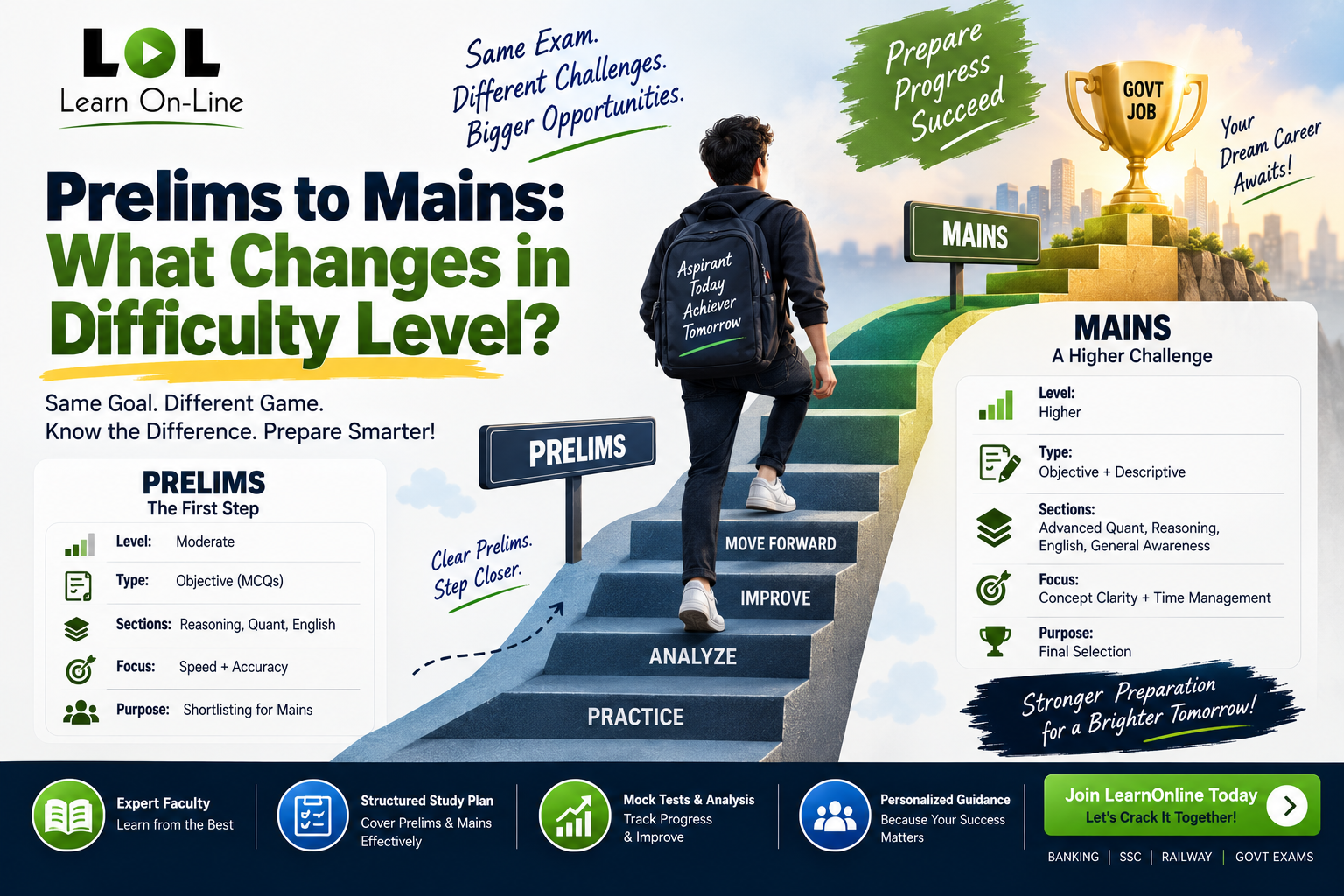
Prelims to Mains: What Changes in Difficulty Level
Every year, a familiar pattern repeats. An aspirant clears Prelims comfortably, feels confident, then hits Mains and struggles far more than expected. This isn’t bad luck. The Prelims-to-Mains difficulty jump is real, and it’s consistent across SSC, Banking, and most other government exams. Once you know exactly what changes, you can prepare for them instead of being surprised. If you’re still building your base before Mains becomes relevant, our Banking Exam Preparation Roadmap covers that groundwork first.
Why Prelims Feels Easier Than It Is
Prelims is a qualifying stage in most exams. It tests whether you can handle the basics under time pressure, not whether you’ve mastered every topic deeply. Questions tend to be shorter and more direct, often testing a single formula or rule in isolation. This makes Prelims feel manageable even with surface-level preparation, and many aspirants pass it while still carrying real gaps in their fundamentals. That surface-level comfort is exactly what trips people up later, because Mains doesn’t work the same way.
What Actually Changes at the Mains Stage
Question Depth Increases Sharply
Mains questions rarely test a concept in isolation. They combine two or three concepts into a single question, forcing you to apply multiple steps before reaching an answer. A Quant question that took 30 seconds in Prelims might take two full minutes in Mains because it tests three ideas at once instead of one.
New Sections Get Added
Most exams add sections in Mains that didn’t exist in Prelims. Banking exams add General/Financial Awareness and Computer Aptitude. SSC exams often shift toward more advanced English and deeper GK. These sections carry real weight, and skipping their preparation until after Prelims clears leaves far too little runway.
Time Pressure Gets Tighter, Not Looser
Despite the added difficulty, the time per question in Mains often shrinks rather than growing to match. Prelims usually allows a slightly more comfortable pace per question. Mains demands both speed and depth at the same time, which is precisely why aspirants who only trained for Prelims-level speed struggle here.
Negative Marking Stakes Rise
Since Mains marks often carry more weight toward final merit, a careless guess costs more than it did in Prelims. Aspirants need a sharper sense of when to attempt a question and when to skip it, calibrated specifically for Mains-level stakes rather than Prelims-level ones.
A Simple Comparison
| Factor | Prelims | Mains |
|---|---|---|
| Purpose | Qualifying stage | Merit-deciding stage |
| Question style | Single-concept, direct | Multi-concept, layered |
| Sections | Core subjects only | Core subjects + specialized sections |
| Time per question | Slightly more comfortable | Tighter, despite greater difficulty |
| Negative marking impact | Lower stakes | Higher stakes |
How to Prepare for the Jump
Don’t wait for your Prelims result to start Mains-level practice. Begin layering in multi-concept questions once your basics are solid, even while you’re still in the Prelims preparation phase. Start Banking or Financial Awareness early too, since it rewards long-term memory far more than last-minute cramming ever can.
Once your Prelims result is out, shift immediately into full Mains-pattern mocks rather than continuing Prelims-level practice out of habit. If you’re within a month of your Mains attempt, our 30-Day Revision Strategy walks through exactly how to structure that final stretch.
It also helps to know your own recurring weak spots going in. Our post on common banking exam mistakes covers several habits that hurt candidates specifically at the Mains stage, not just in Prelims.
This gap between Prelims and Mains is exactly what structured coaching is meant to close. Learn more about our approach at LearnOnline if you’d rather follow a guided plan than piece one together on your own.
Final Word
The jump from Prelims to Mains catches people off guard because Prelims success creates false confidence. The exams aren’t testing the same skill at two difficulty levels. They’re testing different things entirely — recognition and speed in Prelims, application and depth in Mains. Prepare for that shift deliberately, and the transition stops feeling like a shock.
Exam patterns and section weightage can change between recruitment cycles — always confirm the current Mains pattern from the official notification, such as ibps.in for banking exams or ssc.gov.in for SSC exams, before finalizing your preparation strategy.