
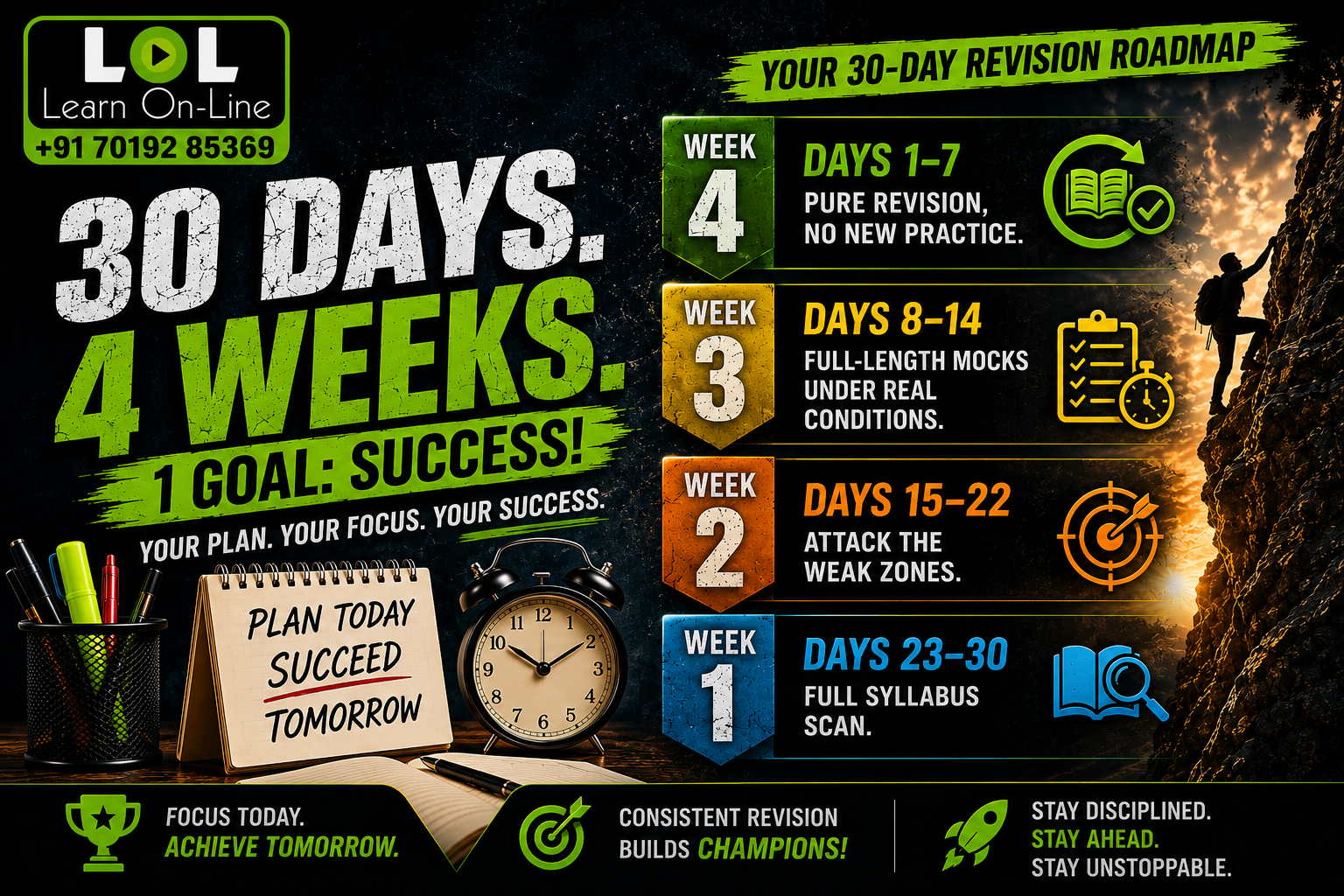
Revision Strategy for Last 30 Days Before Exam
The last 30 days before a government exam are not for learning new topics — they’re for converting everything you’ve already studied into speed, accuracy, and recall under pressure. Yet most aspirants waste this window either by trying to “finish the syllabus” in a panic or by revising randomly without a plan.
This 30-day revision strategy is built specifically for SSC, Banking, and Railway aspirants who want a structured, exam-oriented final month — one that sharpens what you know instead of adding more to learn.
Why the Last 30 Days Are Different
By this stage, your goal shifts from coverage to conversion. You’re no longer building knowledge — you’re building exam-day performance. That means three things matter far more now than they did three months ago:
- Speed — how fast you can solve a known question type
- Accuracy — how often you get it right under time pressure
- Recall — how quickly facts, formulas, and shortcuts surface without hesitation
Starting a new chapter now almost always backfires — it eats into revision time and creates last-minute doubt on topics you hadn’t touched before.
Week 1 (Days 30–23): Full Syllabus Scan
Don’t dive into weak areas yet. First, do a rapid scan across the entire syllabus to identify exactly where you stand.
- Go through your notes chapter-wise, spending 20-30 minutes per topic — not solving questions yet, just refreshing formulas, rules, and concepts
- Maintain a simple three-column tracker: Strong / Average / Weak for every topic
- Attempt one full-length mock test at the end of the week to get a baseline score
This scan tells you where the next three weeks should actually go — without it, revision becomes guesswork.
Week 2 (Days 22–15): Attack the Weak Zones
This is the week to fix what’s broken, not polish what’s already working.
- Pick 2-3 weak topics per day based on your Week 1 tracker
- For each weak topic: revise the concept (15 min), solve 20-25 targeted questions (30-40 min), then review every mistake immediately
- Take 2 sectional tests this week — focus specifically on the sections that pulled down your Week 1 mock score
- Keep an error log — a notebook or spreadsheet where every mistake is written down with the reason you got it wrong (silly error, concept gap, time pressure)
The error log is the single most underused tool in exam preparation. Reviewing it in Week 4 is often more valuable than another 50 practice questions.
Week 3 (Days 14–8): Full-Length Mocks Under Real Conditions
By now, your weak areas should be noticeably stronger. Shift entirely toward full-length, timed mocks that simulate the actual exam.
- Attempt one full mock every alternate day, strictly within the exam’s time limit
- Spend at least 45 minutes analyzing each mock — not just checking the score, but understanding why each wrong answer went wrong
- Track your accuracy percentage and attempt rate across mocks — improvement in these two numbers matters more than the raw score
- Revise formulas, static GK, and current affairs in short 15-20 minute bursts between mocks, rather than long sessions
This week builds exam stamina — sitting through a 60-90 minute test without losing focus is a skill in itself, and it needs practice just like any topic.
Week 4 (Days 7–1): Pure Revision, No New Practice
The final week is about consolidation, not testing yourself further.
- Go through your error log from the last three weeks — this alone will cover most of your weak spots
- Revise short notes, formula sheets, and static GK lists you’ve built through your preparation
- Take at most 1-2 light mocks, purely to stay in exam rhythm — avoid heavy full-length tests in the last 2-3 days
- From Day 2 before the exam, stop solving new questions entirely — only revise what you already know
- Prioritize sleep and a consistent routine over squeezing in extra hours; a tired brain underperforms regardless of how much was “covered”
Common Mistakes to Avoid in the Final Month
- Starting new topics in the last two weeks purely out of anxiety about “gaps”
- Skipping mock analysis — attempting mocks without reviewing mistakes wastes most of their value
- Comparing scores with others on forums or groups, which usually adds stress without adding preparation
- Over-revising strong areas while weak topics stay untouched, because revising what you already know feels more comfortable
- All-nighters before the exam — sacrificing sleep for last-minute revision almost always reduces exam-day performance
A Simple Daily Structure for the Final Month
- Morning: One focused revision block (concepts + formulas)
- Midday: Practice questions or a mock test
- Evening: Mistake analysis and error log review
- Night: Light revision of static topics (GK, vocabulary) before sleep
Keeping this rhythm consistent across all 30 days matters more than any single “perfect” study day.
Final Word
The last 30 days won’t make up for months of missed preparation, but they can absolutely be the difference between a good score and a great one — if used with structure instead of panic. Scan first, fix weak zones next, simulate the real exam, then consolidate. That sequence, repeated with discipline, is what turns preparation into performance on exam day.
Bookmark this page and revisit it at the start of your own 30-day countdown — the plan works best when followed week by week, not read once and forgotten.
 English